Greenwatch's Fellowship Hosting: Building Capacity for Environmental Justice

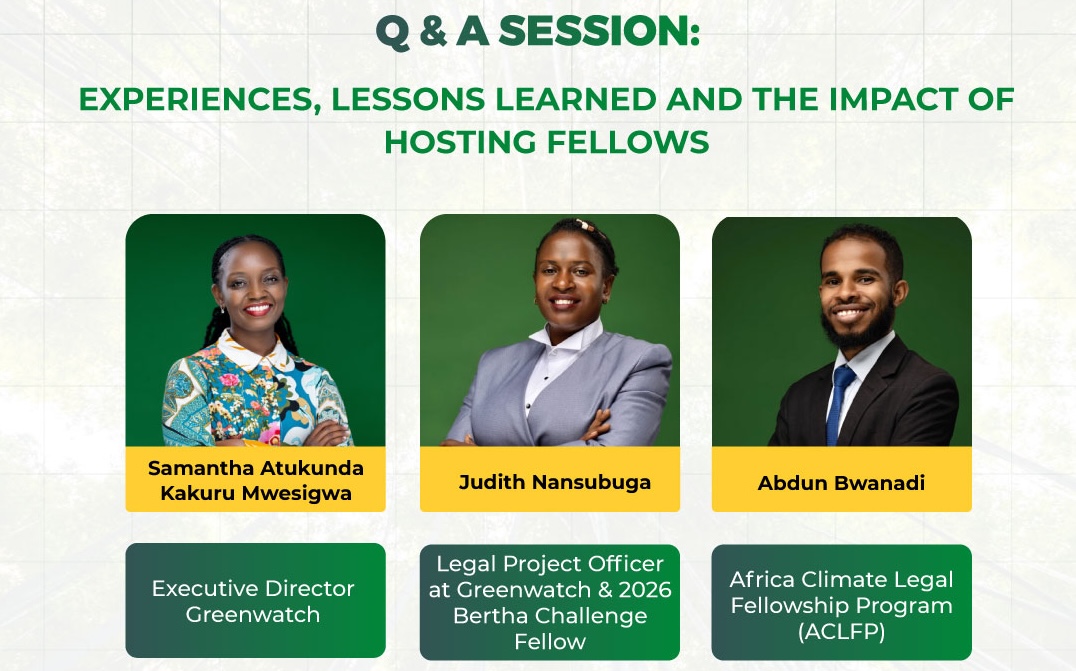
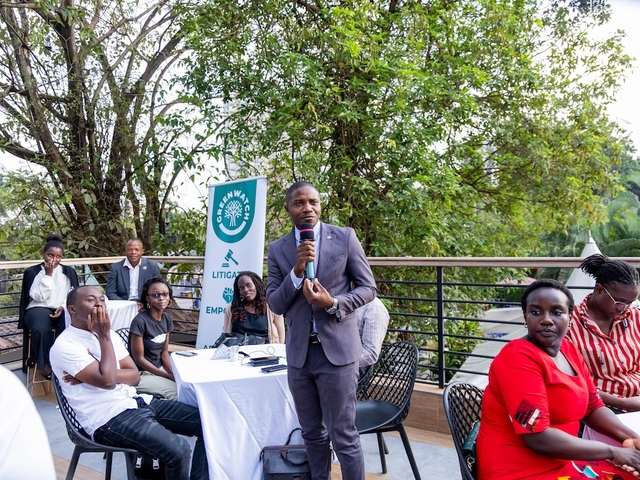
In this article, we reflect on Greenwatch’s journey from our foundational work in environmental advocacy to key milestones that have shaped our growth. In this Q&A, we speak with Judith Nansubuga, Abdun Bwanadi, and our Executive Director, Samantha Atukunda Kakuru Mwesigwa, who share insights on the organisation’s experiences, lessons, and impact over time. Their perspectives highlight how Greenwatch has evolved to host fellowships, strengthening our commitment to mentorship and shared learning.
- Q & A Session: Judith Nansubuga
Question: Could you briefly introduce yourself, your role at Greenwatch, and how you became involved as a fellow under the Bertha Challenge Fellowship?
Answer: My name is Judith Nansubuga, and I am a Legal Project Officer at Greenwatch and a 2026 Bertha Challenge Fellow.
My journey to the Bertha Challenge Fellowship began through Greenwatch’s leadership networks. The Executive Director identified the opportunity through one of these networks and shared it with me, recognizing its strong alignment with my professional interests and Greenwatch’s mission. I applied with great enthusiasm and following a competitive process, was shortlisted and ultimately selected as a 2026 Bertha Challenge Fellow. The Bertha Challenge Fellowship offers an opportunity to activists, lawyers and investigative journalists to spend a year focusing intensively on a pressing social justice challenge within their respective communities aimed at advancing Justice, Accountability and Systemic Change.
This journey was made possible through the encouragement and institutional support within Greenwatch which reaffirmed to me Greenwatch’s core values of Professional Development and Environmental Justice.
Question: From your experience, what makes Greenwatch a strong and supportive learning environment for fellows particularly in terms of litigation experience, climate litigation exposure, fieldwork, and mentorship?Answer: From my experience, Greenwatch has a strong track record of hosting fellows and providing meaningful professional development through hands-on engagement and strategic guidance.
Greenwatch’s partnership with the International Research & Exchanges Board (IREX) under the African Climate Legal Fellowship Program (ACLFP) through which Abdun Bwana Bwanadi was hosted as a Fellow, clearly demonstrates its mentorship strength and capacity to support fellows in making impactful contributions. Observing this experience reinforced my decision to select Greenwatch as my host organisation.
With over 30 years of experience in environmental litigation and advocacy, Greenwatch has played a key role in shaping Environmental Jurisprudence in Uganda. Fellows benefit from this deep institutional knowledge through access to experienced mentors, strategic networks and practical legal resources.
Most importantly, Greenwatch’s practice-oriented approach exposes fellows to real-world Environmental and Climate challenges through direct engagement with affected communities, including those impacted by landslides in Bududa and Host Communities for instance the Mawero Mining Host Community. By integrating fieldwork, community engagement and strategic litigation, Greenwatch equips fellows with both strong legal research skills and hands-on Climate Litigation experience, making it a uniquely valuable learning environment for environmental justice practitioners.
Question: In what ways do fellows contribute to Greenwatch’s legal work, and how does their involvement strengthen Greenwatch?Answer: As an Environmental Law Advocacy organisation, Greenwatch’s core strength lies in Environmental and Climate litigation. Most fellows hosted by the organisation are legally trained which significantly strengthens Greenwatch’s institutional capacity. Fellows actively contribute to legal representation of affected communities, legal research, strategic litigation, advocacy initiatives and other core legal functions.
Through their involvement, fellows not only gain professional experience but also enhance Greenwatch’s ability to deliver high-impact legal services and advance Environmental Justice. This mutually reinforcing relationship ensures that fellowship programs add lasting value both to the individual fellows and to Greenwatch’s broader mission.
THANK YOU.
- Q & A Session: Abdun Bwanadi
Question: Take us back to the moment you decided to apply for the fellowship what drew you to Greenwatch, and what were you hoping to gain from the experience and what did you gain?
Answer: I decided to apply for the Fellowship because, coming from the coastal region, I had seen firsthand how climate change is already affecting communities through rising sea levels, environmental degradation and the loss of livelihoods. At the time, I was practicing law but felt the need to deepen my understanding of climate change and environmental litigation so that I could better advocate for affected communities back home.
The Fellowship stood out to me because it was intentionally designed to equip experienced lawyers with practical knowledge and skills in climate and environmental law, while grounding that work in community empowerment. I saw it as a meaningful opportunity to learn, grow and transition into a space where the law could be used as a tool for climate justice.
Fellows did not choose their host organizations rather, placements were made by the Fellowship organizers. Greenwatch was selected as my host because its work strongly aligns with the Fellowship’s objectives, particularly its focus on community empowerment, advocating for environmental protection and strategic climate litigation. Through my time at Greenwatch, I gained hands-on experience in climate-related litigation, community engagement and advocacy, as well as a much deeper understanding of how legal work can support communities on the frontlines of climate change.
Overall, the Fellowship equipped me with the knowledge, confidence and practical skills needed to continue advancing climate and environmental justice in my work.
Question: Can you share a story or experience from your fellowship that best captures the kind of work you were involved in and what a typical day at Greenwatch looked like for you?
Answer: One experience that best captures the kind of work I was involved in during the Fellowship was my participation, on behalf of Greenwatch, in a technical task force meeting for the review of the Forestry and Tree Planting Act. This was one of many meaningful engagements during my placement, but it stood out because it allowed me to contribute directly to the review of a law that plays a critical role in environmental protection and natural resource governance. Being part of a process that will shape how forests are protected and managed in the long term was both humbling and motivating and it reinforced the importance of legal advocacy in addressing climate and environmental challenges.
A typical day at Greenwatch was equally enriching. The organization offers a supportive and resource-rich working environment that encourages learning and collaboration. There is a strong culture of trust and mentorship our leadership consistently empowers the team, giving us space to take responsibility and grow. This supportive atmosphere made it easy to engage deeply with research, litigation, community work and policy processes and ensured that professional growth happened naturally as part of the work.
The combination of impactful legal work and a positive, enabling work environment made my Fellowship experience at Greenwatch both meaningful and transformative.
Question: How did this fellowship shape you—professionally and personally and what moments or lessons stand out as having the biggest impact on your growth?
Answer: The Fellowship shaped me profoundly, both professionally and personally. Professionally, it gave me the confidence, skills and practical exposure to operate effectively in the climate and environmental justice space. Coming from a general legal background, the Fellowship helped me transition into climate litigation, policy engagement and community-centered advocacy, grounding my legal practice in real-world environmental challenges.
Several moments stand out as especially impactful. Being selected for leadership training at Oxford was a defining experience, it strengthened my strategic thinking, exposed me to global perspectives on climate leadership and affirmed the importance of ethical, values-driven leadership in climate action. It challenged me to think beyond cases and institutions and to see my role within a broader global movement for climate justice.
Another pivotal moment was being selected as a speaker at a COP30 side event on Climate Justice Day. Representing the voices of affected communities on an international platform was both humbling and empowering. It reinforced the importance of linking grassroots realities with global climate conversations and strengthened my ability to communicate complex legal and climate issues to diverse audiences.
Beyond these milestones, the Fellowship instilled discipline, resilience, and a deeper sense of purpose. Working closely with communities, mentors and fellow Fellows taught me the value of collaboration, humility and consistency in impact-driven work. Personally, it sharpened my sense of responsibility to use the law not just as a profession, but as a tool for justice, protection of the environment and service to communities on the frontlines of climate change.
Overall, the Fellowship did not just expand my skill set, it reshaped how I see my role as a lawyer and as a climate justice advocate.
Question: Looking back now that the fellowship has ended, what has stayed with you the most, and what would you say to someone considering becoming a fellow at GreenwatchAnswer: Looking back now that the Fellowship has formally ended, what has stayed with me the most is the sense of continuity and purpose it created. While the core Fellowship was for one year and has come to an end, I am still with Greenwatch under the same Fellowship framework through an additional six-month bridging period. That in itself speaks to the value of the work, the trust built and the mutual commitment to sustaining impact beyond the formal program timeline.
What has stayed with me most is the confidence the Fellowship instilled in me, confidence to engage in complex climate and environmental matters, to represent communities, to contribute to policy and litigation processes and to speak in national and international spaces. The exposure, mentorship and hands-on work have fundamentally shaped how I approach my role as a lawyer and advocate.
To anyone considering becoming a Fellow at Greenwatch, I would say this: you will learn immensely, not just in theory but through real, meaningful work. You gain confidence, new opportunities and a deeper understanding of climate and environmental justice. Greenwatch provides a supportive, trust-based environment that encourages growth, initiative and responsibility. If you are looking for a place where your legal skills can be sharpened while making tangible impact for communities and the environment, Greenwatch is a truly enriching place to be.
- Q & A Session: Samantha Atukunda Kakuru Mwesigwa
Question: Looking back, what inspired Greenwatch to open its doors to fellows, and how does this decision connect to your personal and professional vision for the organisation?
Answer: Opening our doors to fellows was not something we had initially set out to do as part of a long-term plan. Instead, it emerged organically through our engagement with the Environmental Law Alliance Network (ELAW), a global network of environmental lawyers who share experiences, challenges, and best practices across different regions. Being part of this network exposed us to the power of collaboration and learning through exchange.
On both a personal and professional level, the fellowship aligns with our vision at Greenwatch as an organisation that is people-centred and committed to building capacity within the environmental justice movement. It reflects our belief that strengthening institutions also means investing in individuals and creating spaces where knowledge, mentorship, and practical experience can intersect.
Question: Can you share a moment or experience where you saw a fellow’s work make a real difference—either within Greenwatch or in the communities and causes the organisation serves?Answer: Since this was Greenwatch’s first time hosting a fellow, the impact was quite significant. One defining moment for us was seeing how the fellow’s professional background shaped our internal working culture. Coming from a traditional law firm environment—which is often more fast-paced and deadline-driven than civil society organisations—the fellow brought a strong emphasis on efficiency, structure, and timely delivery of legal work.
This influenced how we approached legal drafting, advocacy responses, and internal processes. It pushed us to improve our turnaround times and adopt more structured ways of working, ultimately strengthening our effectiveness as an organisation. That experience made it clear to us that fellows do not just learn from the organisation—they also meaningfully contribute to its growth.
Question: From your perspective as Executive Director, how does Greenwatch create an environment where fellows can learn, grow, and meaningfully contribute, particularly in areas like advocacy, empowerment, and litigation?Answer: At Greenwatch, we are intentional about ensuring that fellows are actively engaged rather than treated as passive observers. We involve them directly in our advocacy work, community empowerment initiatives, and litigation processes, allowing them to work on real cases and real issues affecting communities.
Fellows are encouraged to contribute ideas, interact with communities, and take responsibility for specific tasks, while also receiving mentorship and guidance from experienced staff. This balance between hands-on engagement and supportive supervision creates a learning environment where fellows can build confidence, sharpen their skills, and develop a deeper understanding of environmental justice practice.
Question: As you look to the future, what role do you see fellows playing in strengthening Greenwatch’s impact, and what message would you share with young professionals considering this fellowship journey?Answer: Looking ahead, I see fellows continuing to play a vital role in strengthening Greenwatch’s impact. They bring fresh perspectives, new energy, and innovative ideas that help the organisation remain dynamic and responsive to emerging environmental challenges.
To young professionals considering this fellowship journey, I would say this is more than just an opportunity to gain experience. It is a chance to contribute meaningfully to environmental justice work, to learn from practice, and to grow both professionally and personally. Come with an open mind, a willingness to learn, and a commitment to making a difference—the experience will shape you in ways that extend far beyond the fellowship period.

Greenwatch
We believe that environmental rights can be better exercised when people have access to information, can participate in decisions that affect their surroundings and have access to justice incase their rights are violated. Greenwatch exists to ensure that every individual in Uganda knows that they have environmental rights and these rights can be fully exercised through access to information, justice and public participation.